

Quick Answer: Laser treatment may help jowls when there is a small amount of sagging skin, because controlled heat can prompt gradual collagen remodeling. With a lot of sagging, the American Academy of Dermatology says skin tightening may not help. In that case, a surgical consultation is one option to discuss. Which applies to you is decided at an in-person evaluation.
In this article
Jowls can sneak up on you. You see a photo taken from a low angle, and the jawline that used to look crisp now softens at the edges. If you’ve started searching for laser treatment for jowls, there’s often a second question underneath the first: do I need a facelift yet?
The answer depends on how much sagging there is and what’s causing it. Laser treatment may produce modest, gradual change in loose skin along the jawline when there is a small amount of sagging, and whether it fits you is decided at an in-person evaluation. The American Academy of Dermatology (AAD) says good candidates for skin tightening have “a small amount of sagging skin.”
The other half of the answer matters just as much. Laser tightening isn’t the same as a surgical facelift, and the AAD is direct about the limits: “Do you have lots of sagging skin? If so, skin-tightening may not be helpful.” Which group you fall into isn’t something a mirror or an online quiz can settle. It’s decided at an in-person evaluation.
At Omnia, we use Fotona’s Nd:YAG and Er:YAG laser platform, and we’ll tell you plainly whether we think a laser fits your jawline or whether another conversation makes more sense.
What Causes Jowls?
Jowls aren’t only a skin issue. Anatomy research points to several changes in the lower face that can contribute, including a distinct jowl fat compartment, weakening retaining structures, buccal fat descent, and bone resorption along the jaw, alongside looser skin as collagen production decreases. Here’s what each one means:
- A distinct jowl fat compartment. The lower face has its own compartment of fat in the jowl area.
- Weakening retaining structures. The fibrous structures that anchor facial soft tissue can loosen with age, and tissue can then descend.
- Buccal fat descent. Fat that sits deeper in the cheek can move downward over time and contribute to the jowl.
- Bone resorption along the jaw. The facial skeleton changes with aging, and bone loss just in front of the jowl can add to its appearance.
Skin changes are part of the picture as well. As we age, collagen production decreases, and skin along the jawline can become looser and less defined.
This matters for treatment. A laser works on skin. It doesn’t reposition fat or rebuild bone, so what it can do for your jowls depends on which of these changes is doing most of the work.
How Can Laser Treatment for Jowls Help?
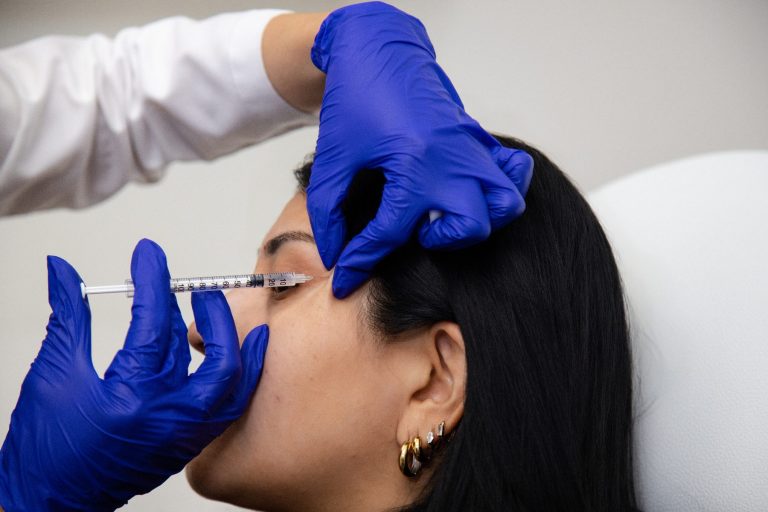
Laser skin tightening is based on controlled delivery of energy into targeted tissue. According to the AAD, some lasers can send heat deep into the skin without wounding the top layer. That heat can trigger collagen contraction and, over the following months, collagen remodeling, which may gradually improve firmness along the jawline.
At Omnia Wellness Center, we use Fotona laser technology to deliver controlled energy at different tissue depths, with the goal of stimulating collagen remodeling and improving firmness over time. For someone with a small amount of sagging skin, that can mean a jawline that looks a little firmer and more defined. It won’t look like a different face, and it shouldn’t.
What Can’t Laser Treatment Do for Jowls?
Laser tightening isn’t the same as a surgical facelift. It doesn’t remove excess skin or reposition deeper tissue. If you have a lot of sagging skin, the AAD’s guidance is that skin tightening may not be helpful, so a laser series may not give you the change you’re hoping for.
In that situation, a consultation with a board-certified plastic surgeon is one option to discuss. A plastic surgeon writing on the American Society of Plastic Surgeons (ASPS) blog lists sagging or loose jawlines among the reasons to consider a traditional facelift. We’d sooner say that at the start than sell you treatments that can’t meet your goals.
Some people aren’t ready for surgery or simply don’t want it. That’s a valid choice, and the goal is to make it with accurate expectations. Our article on whether Fotona4D® is worth the money walks through that decision.
What Other Options Are There for the Jawline?
Because jowls involve more than skin, a laser isn’t the only tool. Depending on your anatomy, dermal fillers, biostimulator injections, a combined plan that pairs laser treatment with an injectable, or a surgical consultation may come up when you meet with your provider. Here’s how each one fits:
- Dermal fillers add volume in targeted areas. Whether filler suits your jawline depends on your anatomy.
- Biostimulator injections are designed to prompt the body’s own collagen production gradually.
- A combined plan may pair laser treatment with an injectable, spaced out over time.
- A surgical consultation may be worth having when there is a lot of sagging skin.
What Should You Expect From Treatment?
Laser treatment for jowls is gradual. Your body needs time to remodel collagen, and the AAD says results from non-invasive laser tightening gradually appear between 2 and 6 months after the last treatment. For Fotona4D®, Fotona, the manufacturer, describes a series of commonly 3 to 7 sessions scheduled 4 to 6 weeks apart. Your provider sets the number.
Before recommending a plan, we evaluate your skin quality and the degree of laxity along your jawline, and we talk through what you’re hoping to achieve. Our Fotona4D® cost guide covers pricing per session.
Frequently Asked Questions
How many laser sessions will my jowls need?
It depends on your skin and how much sagging there is. For Fotona4D®, Fotona describes a series of commonly 3 to 7 sessions scheduled 4 to 6 weeks apart. Your provider sets the number after an in-person evaluation.
Can filler help jowls?
Filler adds volume in targeted areas, so it may be part of a jawline plan for some people. It doesn’t tighten loose skin. Whether it suits your anatomy is decided at an evaluation.
How is the amount of sagging assessed?
Your provider examines your face in person, looking at your skin quality and at how the tissues of your lower face and jawline have changed. That assessment, together with your health history and goals, shapes which options fit. A photo or an at-home check can’t make that call.
Is laser treatment for jowls the same as a facelift?
No. Laser tightening is non-surgical and works on the skin. A surgical facelift is a separate procedure, and a plastic surgeon writing on the ASPS blog lists sagging or loose jawlines among the reasons to consider one.
Book a Consultation in Encino
If your jawline has been on your mind, an evaluation can clarify which options fit your face. Omnia Wellness Center is at 16430 Ventura Blvd, Suite 207, Encino, in the San Fernando Valley. Schedule a consultation to discuss your goals. Call (818) 386-8511 or text (818) 853-1351.
This article is for general informational purposes and is not medical advice. It does not replace an evaluation by a qualified licensed medical provider. Individual results vary.


